Platform Record intelligence
Record intelligence
Know what’s solid, what’s stale and what’s missing.
Underneath every part of the record, Olomon keeps track of where each fact came from, whether a person confirmed it, whether it’s still current, and what’s missing around it. So the household and its advisors know how far to trust it.
Four things it tracks
Every fact, from four sides.
These are different questions, and a value can be solid on one and weak on another: read from a statement, but last updated a year ago.
Origin
Where did this come from?
- From a feed or statement
- Read from a document, with its page
- Entered by hand, by a named person
Confidence
Has a person confirmed it?
- Check this: Olomon isn't sure of its reading
- Accepted, with who and when
Freshness
Is it still current?
- Stale: update it, or confirm it's still right
Completeness
What's missing or unresolved?
- Not recorded, never guessed
- An expected document that hasn't arrived
- Two sources that disagree, as a question for a person
Gaps
What’s missing, and who can fill it.
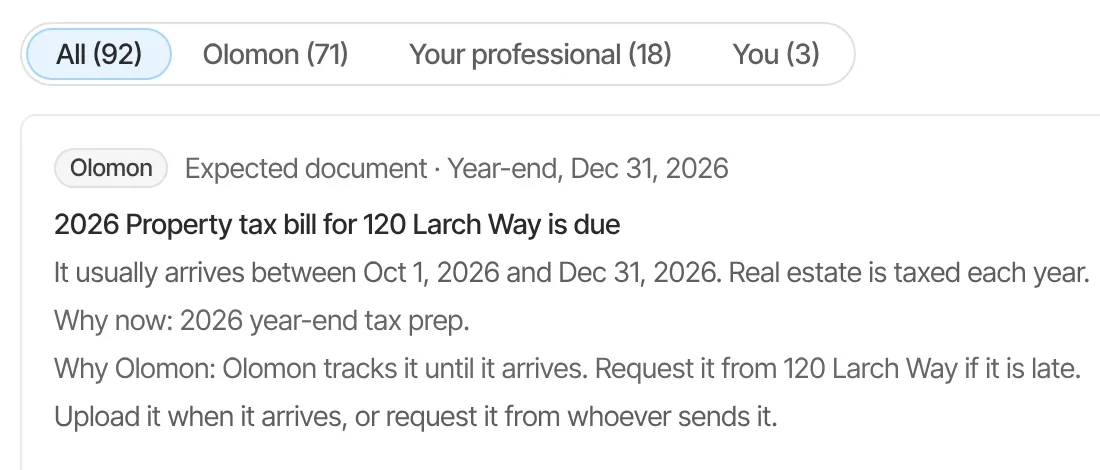
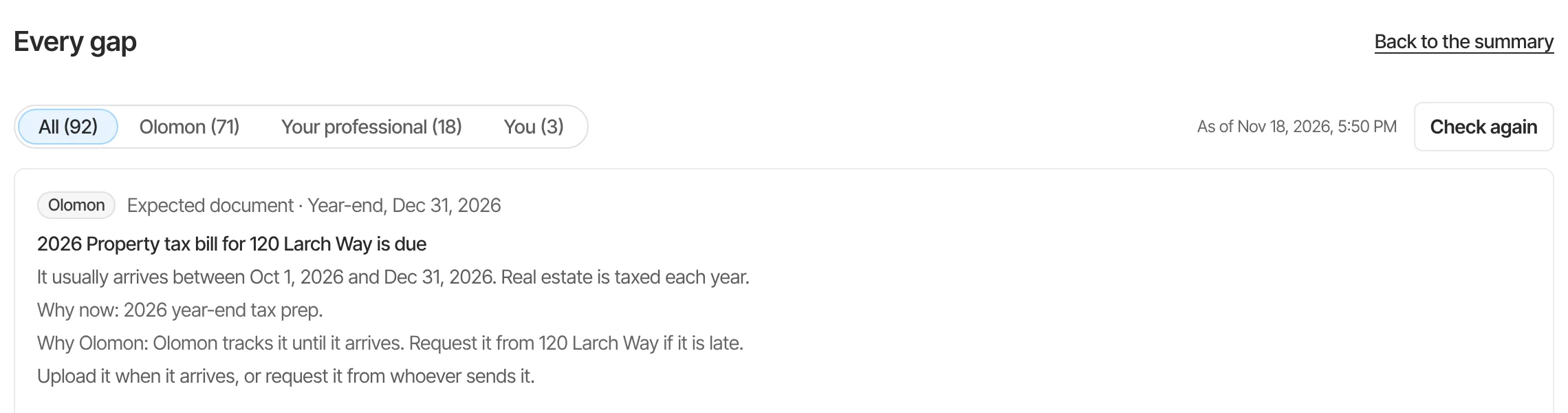
Every gap says whether Olomon, a professional or the family can close it, and why it matters now. The family’s summary leads with the few things only it can answer; the full list is there for anyone who wants it.
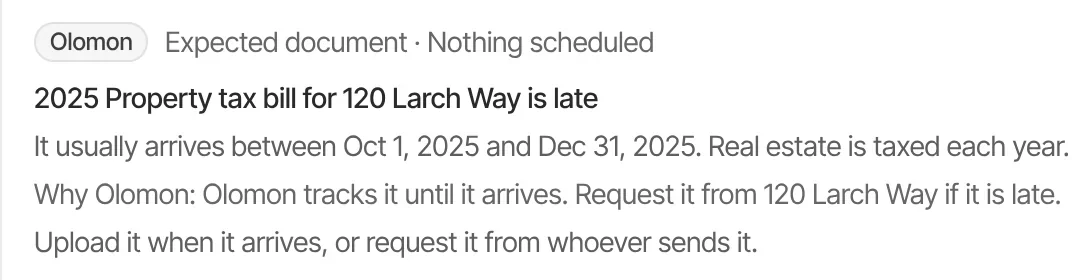
Documents it expects.
Because there’s a mortgage, a property or an account on record, Olomon knows which tax forms and statements should arrive for the year, and marks each one not yet due, due, received or late.

Every night
It notices before you have to.
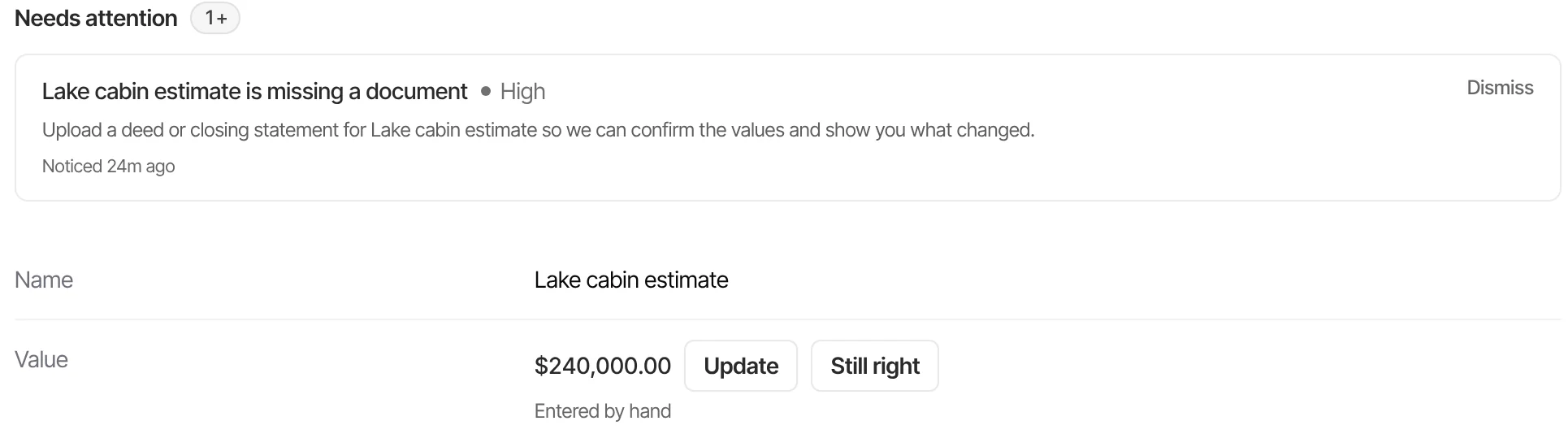
Nightly scans look for what’s gone wrong or out of date, and open a finding someone can resolve, acknowledge or dismiss:
- Hand-entered values that have gone stale
- Documents that should be on file and aren't
- Material changes
- Values whose confidence has dropped
- Expired policies
- Missing coverage
- Sources that disagree
- A lien with no loan behind it
For advisors
Checks across the record, for the people who advise on it.
Olomon flags what doesn’t line up for the household’s advisor to look at. It doesn’t give advice; it makes sure the advice starts from the whole picture.
Checks across records
- Beneficiaries that differ between a policy and a trust
- Coverage that looks too low for what it protects
- Required minimum distributions approaching
- Entities with nothing linked to them
- Insurance documents that contradict each other
- Concentration in a single holding
- Umbrella and liability limits that don't line up
Unusual activity
- A balance that jumps
- A regular payment that stops
- Activity in a dormant account
- A new payee taking a large share
- A spike in transactions
- A valuation far outside its history
Olomon also calculates a record health score for each household, from five weighted pillars. The advisor sees the score; the family sees its own view of how far to trust its record. See it in the professional workspace.
When sources disagree
Disagreement is a finding, not a silent overwrite.
When two sources give different values for the same thing, Olomon keeps both claims, each with its source, and opens a finding. A person marks which one was checked against its source, or accepts the value despite the conflict.
Connected in the record
Intelligence runs underneath every area.
Documents to facts
What documents say feeds what's known, and a document that should exist but doesn't becomes a gap.
Professional workspace
Advisors see each household's health score, which is shown to them rather than the family, and every finding in one queue across their clients.
Net worth and income
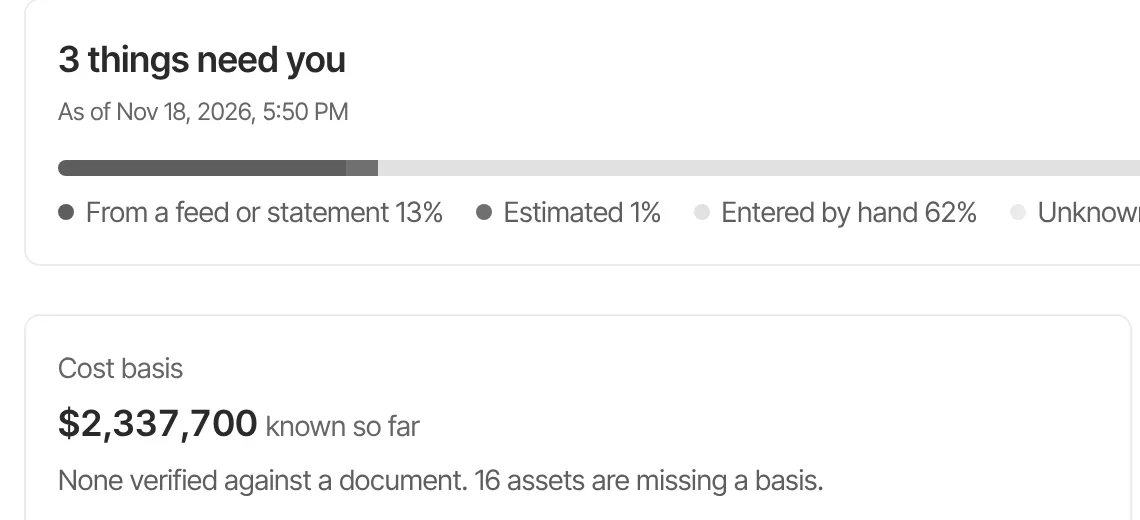
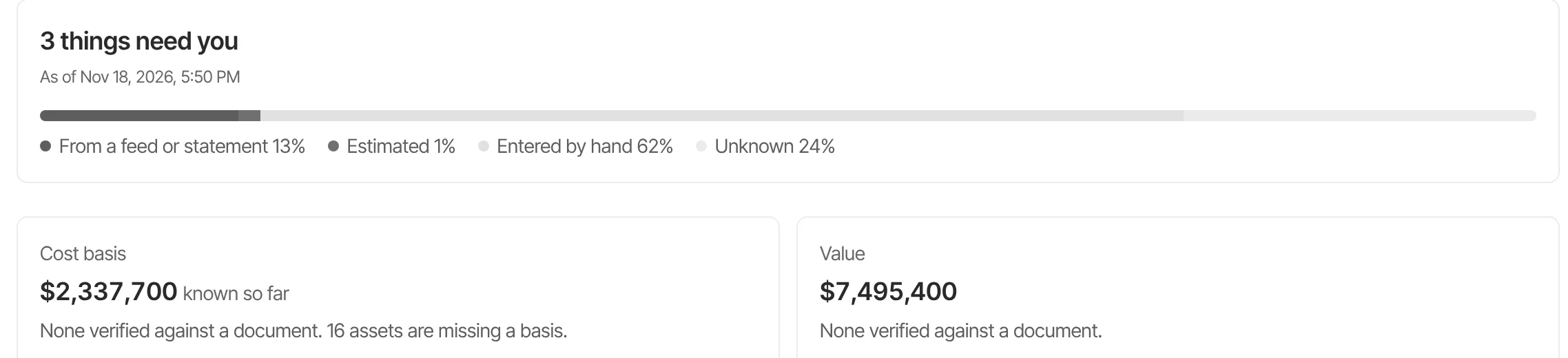
The family sees how much of its value came from a feed or statement, was estimated, was entered by hand, or is still unknown.
See how far your record can be trusted.
In the demo we walk through a sample household’s gaps, stale values and findings. There’s nothing to send beforehand.